
Travel and Expense Reimbursement Procedures Issuing Authority: Office of the President
Responsible Officers: Chief Operating Officer / Vice President for Finance and Treasurer Date Effective: July 1, 2022
Purpose and Scope
It is the policy of Temple University – Of The Commonwealth System of Higher Education (the “University”) to reimburse travelers for reasonable and necessary expenses incurred during approved work-related travel. Travelers seeking reimbursement should incur the lowest reasonable travel expenses. Reimbursement is allowed only when reimbursement has not been, and will not be, received from other sources. If a circumstance arises that is not specifically covered in the accompanying procedures, then the most conservative course of action should be taken. These Procedures should be read and applied in conjunction with the University’s complete listing of policies and procedures, including the University’s policies on conflict of interest and procurement.
These Travel and Expense Reimbursement Procedures (the “Procedures”) provide guidance and instructions for the booking, submission, review, and approval of travel and related charges and reimbursements. Any and all travel by employees of the University or other individuals traveling on approved University business (collectively “Travelers”), as well as any and all travel-related expense reimbursement requests, must be in compliance with these Procedures. Requests for reimbursement not in compliance with these Procedures will not be approved. Failure to comply with the Procedures herein may result in disciplinary action.
|
|
Page |
|
Page |
|
1. Booking |
2 |
4. Lodging (Hotel/Motel) (continued) |
7 |
|
2. Airline Travel |
2 |
H. Philadelphia Lodging |
|
|
A. Ticket Class |
|
I. Private Residence Lodging |
|
|
B. Timing |
|
J. Local Lodging |
|
|
C. Luggage |
|
K. Incidental Expenses |
|
|
D. Wi-Fi |
|
5. Meals |
9 |
|
E. Flight Change Fees |
|
A. General |
|
|
F. Personal Rewards |
|
B. Personal Meals (Individual) |
|
|
G. Other Supplemental Airline Fees |
|
C. Business Meals |
|
|
H. Unused Flight Credits |
|
D. Meal Receipts |
|
|
I. Business Travel Combined with Personal Travel |
|
E. Conferences |
|
|
J. Weekend Travel |
|
6. Alcohol |
11 |
|
3. Ground Transportation |
4 |
7. Entertainment |
11 |
|
A. Car Rentals |
|
8. Special Occasions |
11 |
|
B. Vans for 12 or More Passengers |
|
9. Catering |
11 |
|
C. Rail Transportation |
|
10. Donations, Contributions, and Sponsorships |
11 |
|
D. Limos, Shuttles, and Ride Share Services |
|
11. Gifts and Flowers |
12 |
|
E. Personal Vehicle |
|
12. Professional Organization Dues/Fees |
12 |
|
F. University-Owned Vehicle |
|
13. Moving Expenses |
12 |
|
4. Lodging |
7 |
14. International Travel |
12 |
|
A. Booking |
|
15. Payment Applications |
12 |
|
B. Conferences |
|
16. Receipts |
13 |
|
C. Rome and Japan Campuses |
|
17. Submission Due Dates |
13 |
|
D. Allowable Room Types |
|
18. Exceptions |
13 |
|
E. Prohibition of Double Occupancy |
|
Appendix |
|
|
F. Personal Rewards |
|
A-1 Sample Car Rental Invoice |
i |
|
G. Receipt Submission |
|
A-2 Sample Transportation Calculation |
i |
|
|
|
A-3 Expense Type Exclusion List |
iii |
- Booking, Generally
All travel arrangements (except travel related to professional conferences, see below) must be made through either the Concur Travel and Expense Management (“Concur”) online tool or World Travel (the travel management company for Temple University). Exceptions will be approved when Concur or World Travel are not able to provide service (e.g. to certain geographical locations or for accommodations that are not available through Concur or World Travel). Concur can be accessed through the TUportal or the Concur mobile application. To reduce booking fees, Travelers are encouraged to utilize Concur as the primary booking method.
- Airline Travel
All air travel must be booked through either Concur or World Travel. There are no out of pocket charges for Travelers when travel is booked through these University sanctioned methods. Air Travel booked outside of World Travel or Concur may not be reimbursed. Repeated violations of this provision may result in disciplinary action.
- Ticket Class
Employees/Non-Employees/Group: Except as noted below, flight arrangements for Travelers must be booked using Standard Economy (Coach). This requirement applies to both employees and non-employee travelers, such as consultants, candidates, or outside speakers.
Flights of 6 continuous hours or greater in length (excluding layovers) may be booked as Business Class, provided that such incremental travel cost is charged to cost centers not supported by student tuition, Commonwealth funds, or grants and contracts; and travel arrangements are approved in advance by the cognizant dean or vice president and above (including officers of the University).
Americans with Disabilities Act (“ADA”) accommodation exception is available. ADA accommodation exceptions require advance approval by Human Resources.
If travel is subject to the Fly America Act, (Federal Travel Regulations, § 301-10), the provider of air travel takes precedence over choosing a less expensive foreign carrier unless noted as an exception under the act.
§ 301-10, https://www.gsa.gov/policy-regulations/policy/travel-management-policy/fly-america-act
- Timing
Except where approved in advance by the cognizant dean or vice president and above (including officers of the University), to avoid premium airfare pricing, flights should be booked a minimum of 14 days in advance of domestic travel and 30 days in advance of international travel. Prior to booking international travel, Travelers are advised to consult Temple’s International Risk Management website for any additional requirements, travel advisories or restrictions.
https://finance.temple.edu/travel-resources/international-travel/advisories-alerts
- Luggage
Standard reimbursement is for a maximum of one checked bag if not already included in the base fare. Reimbursement of the cost of additional luggage shall be provided only to the extent such additional luggage is required for a legitimate business reason approved in advance by the cognizant dean or vice president and above (including officers of the University).
- Wi-Fi or Lounge Wi-Fi/Wi-Fi Subscriptions
Expenses of hotel room Wi-Fi/internet connectivity will be reimbursed for Travelers providing a legitimate business reason.
Expenses for Wi-Fi/internet connectivity in lounges or by subscription are not reimbursable. Additional cost related to secure internet access requires pre-approval of the Chief Information Security Officer or Chief Information Officer.
- Flight Change Fees
Flight change fees are not reimbursable unless the change was made for a legitimate, approved business reason. Substantiation for the related change, including business reason and supervisor approval, must be provided at the time of expense report submission.
- Personal Rewards
Frequent flyer miles and program rewards not owned by the University may be used at the gate or by calling World Travel or the airline to change a ticket class or boarding status: however, the University will not reimburse Travelers for tickets, upgrades, or other changes to their travel arrangements purchased with frequent flyer miles, personal credit card rewards, or personal airline credits.
- Other Airline Fees
Travelers requiring special travel arrangements (e.g., special seat assignments or early boarding requirements in accordance with the Americans with Disabilities Act or Section 504 of the Rehabilitation Act) must work directly with World Travel to arrange for appropriate accommodations. Travelers are advised to keep their Concur profile current.
In-Flight convenience items, such as movies, headphones, or alcoholic beverages are not reimbursable.
In-flight food and non-alcoholic beverages are reimbursable with receipts or as part of daily meal per diem rate based on the Federal General Services Administration (GSA) Guidelines. See “Meals” below.
- Unused Flight Credits
World Travel will apply any unused flight credit that is within 90 days of expiration and valued at
$500.00 or greater to the next incoming booking regardless of general ledger account code. Monthly credits will be given to the original department that the credit belongs to and the department that receives the flight credit will be charged.
- Business Travel Combined with Personal Travel
Travelers are discouraged from combining business with personal travel. Any change to or extension of University travel made for non-business reasons will not be reimbursed. Allowable reimbursements may not exceed the cost of the most direct travel, and reimbursement shall be made only for the business portion of the trip.
Travelers will be responsible for any costs that exceed the reimbursable costs of the business-related portion of the trip within 30 days of your return from travel.
Travelers must provide documentation that any personal travel did not result in an additional cost to the University. Travelers must provide comparable price quotes from either World Travel or the Concur online booking tool. Such quotes must be obtained at the time of booking the business travel. This documentation must accompany the reimbursement request to avoid delay or denial of reimbursement.
- Weekend Travel
Weekend travel should be avoided domestically, whenever possible, unless required for business. For international travel, travelers may arrive 24 hours in advance of their first workday, regardless of the day of the week.
- Ground Transportation
All car rentals and rail travel must be booked through either World Travel or Concur.
- Car Rentals
Car rental may be selected as the mode of transportation only when less expensive than alternate methods such as taxi, train, and car services (such as Uber and Lyft) or where personal safety concerns are present. When submitting an expense report with a car rental included, Travelers must provide detail to indicate the business purpose for selecting a rental car as the mode of transportation. Travelers under the age of 21 are not permitted to rent a car for travel and will not be reimbursed for such expenses. Whenever two or more University employees travel together, the senior (based on hierarchy) of the Travelers is responsible for renting the vehicle. Refer to the Appendix for a sample car rental reimbursement.
Temple University maintains a list of preferred car rental vendors. Travelers are required to use a Temple preferred vendor where available. If a Temple preferred vendor is not available, Travelers may select another vendor. Rental fees for cars other than through a preferred vendor must be paid upfront, and a written explanation for the use of the non-preferred vendor must be provided at the time of the reimbursement request.
Car rental expenses incurred while attending a conference are usually not reimbursable when flying into the conference city and staying at the conference hotel or within a short distance from the location.
- Car Rental Classes
All car rentals are required to be mid-size or smaller (economy-intermediate). ADA accommodation exception is available.
- Car Rental Insurance
The University’s auto liability insurance covers vehicles rented for business use. Travelers must decline all additional insurance at the time of the rental.
- Car Pick-Up
Travelers must inspect the rental vehicle and report damage to rental agency before and after rental.
- Gas/Refueling
Vehicles must be refueled prior to the return to the rental company. Pre-paid fuel options will not be reimbursed.
- Incidental Expenses/Optional Products
Below is a list of allowable and unallowable expenses related to car rentals. This list is illustrative and not meant to be all-inclusive. Please submit any questions about expenses not included on this list to travel@temple.edu.
- Parking - Allowable
- Tolls - Allowable (Excluding late charges associated with late submission). Additional rental cost for toll pass devices such as, but not limited to, E-ZPass and SunPass will be allowable only if required by state law to be included in the rental.
- Vehicle Upgrades - Unallowable except as required as a reasonable accommodation under the Americans with Disabilities Act.
- Winter Tire Charge - Allowable
See the Appendix for a list of additional unallowable expenses.
- Vans for 12 or More Passengers
Large passenger van rental is permitted only subject to the following limitations:
- The driver of the van is a University employee with a minimum age of 25 and the holder of a valid commercial driver license (CDL)
- A maximum of twelve (12) passengers is authorized.
- Seatbelt use is mandatory for all passengers.
- Luggage or items may not be stacked higher than the bottom edge of the windows.
- Large passenger vans are not authorized for towing purposes.
- No materials may be carried on the vehicle roof.
- Rail Transportation Ticket Class
- All Travelers – Coach class unless unavailable. Business Class or Acela requires prior approval by cognizant dean or vice president and above (including officers of the University).
- ADA accommodation exception is available.
Incidental Expenses (Rail travel only)
- Food and non-alcoholic beverages are reimbursable with receipts or as part of daily meal per diem rate based on the Federal GSA Guidelines. See Meals below.
- Wi-Fi is only reimbursable if required for a legitimate business reason.
- Alcohol is not reimbursable.
- Limousine, Shuttle, and other Ride-Sharing Services such as Taxi, Uber, and Lyft
Limousine, shuttle services, and other ride-sharing services such as taxi, Uber, and Lyft may be used when comparable or less expensive than alternate means of transportation. When traveling with others, it may be economical to coordinate travel times and share the limousine or shuttle service. See the Appendix for examples.
- Personal Vehicle
The use of a personal vehicle is permissible for local travel not related to your normal commute to and from your primary work location. Use of a personal vehicle for round trips in excess of 500 miles requires prior approval by cognizant dean or vice president and above (including officers of the University).
- Mileage Reimbursement (personal vehicle use only)
For miles in excess of your normal commute, the University will reimburse mileage at the current IRS authorized mileage rate. Mileage reimbursement covers all costs related to the operation of the vehicle, including service, insurance, depreciation, and gas. Reimbursement for two or more Travelers in the same vehicle is limited to the mileage reimbursement paid to the driver. Cost incurred related to travel between an employee’s home and primary work location are not reimbursable.
https://www.irs.gov/tax-professionals/standard-mileage-rates
- Inter-Campus Travel
Mileage reimbursement, parking fees, and/or transportation related costs for inter-campus travel between campuses or satellite locations located in Philadelphia and surrounding suburbs (including Philadelphia, Ambler, and surrounding suburban locations) are not reimbursable regardless of the availability of University provided shuttle services.
- Gasoline and Electric Vehicle Charging
The cost of gasoline and/or electric vehicle charging is factored into the mileage reimbursement rate. Gasoline and electric charging are not reimbursable expenses when traveling by personal automobile.
- Tolls
All tolls incurred while traveling for business (except those incurred as part of the Traveler’s normal commute) are reimbursable. Late fees and/or penalties are not reimbursable. Toll receipts or toll device statements (e.g. E-ZPass and SunPass) are acceptable forms of expense documentation.
- Parking
All parking charges for business purposes are allowable outside of the Traveler’s normal commute/parking cost with the exclusion of inter-campus travel between the University’s Philadelphia and surrounding suburban locations.
- Incidental Expenses
- Regular Car Maintenance - Not reimbursable
- Parking Fines/Penalties - Not reimbursable
- Traffic Violations - Not reimbursable
- Towing - Not reimbursable
- Repairs on Personal Vehicles - Not reimbursable
- Incidental Expenses
- University-Owned Vehicles (Departmental or Fleet)
Any vehicle used in the conduct of University business may only be driven by a University employee who holds a valid U.S. driver’s license, regardless of the vehicle’s owner. The University reserves the right to examine and/or periodically check drivers' motor vehicle records and establish eligibility requirements.
- Lodging
- Booking
Travelers may book lodging accommodations either directly through Concur or through other booking service providers. The University does not currently utilize Federal GSA rates for lodging.
- Conferences
For conventions or conferences where there is a reserved room block rate or a combined lodging room fee, lodging may be booked directly with the hotel or through the conference organizers.
When traveling to a conference, it is appropriate to stay at the hotel hosting the conference, assuming that the daily rate is not unreasonably expensive relative to other alternatives.
When traveling to the Rome and Japan campuses, follow the instructions below.
Travelers may use their University purchasing card (“PCard”) to book conference registrations combined with hotel. Travelers without a University PCard must provide a copy of the conference registration showing the conference fees/room rate are combined when submitting the expense report. Prepaid expenses such as hotel and conference fees paid by individuals will not be reimbursed until after the event. Employees are encouraged to charge conference registrations to the department purchasing card, if available. If there are no convention or conference room blocks, hotel reservations can be made through World Travel or Concur.
- Rome and Japan Campuses
When traveling to the University’s Rome or Japan campus, Travelers must select lodging from the list of accommodations available on the TUportal (refer to TUportal → “Budget and Finance” tab
→ “International Travel” section → “TU Japan and TU Rome Hotel Affiliates”). https://tuportal5.temple.edu/web/home-community/bfin
- Allowable Room Types
All Travelers must use a standard single room.
The University prohibits Travelers from booking to Resort or Upper-Upscale or Luxury category Hotels, unless part of a conference or convention package as noted above.
- Prohibition on Double Occupancy
The University prohibits requiring double (or more) occupancy in a hotel room during travel sponsored in whole or in part by the University. Should you be directed to share a room by your supervisor, please bring this to the attention of Human Resources immediately at elrel@temple.edu.
- Personal Rewards
Any room upgrades using rewards, miles, or other forms of personal credits are considered a personal expense and are not reimbursable.
- Receipt Submission
Final paid hotel folio or paid itemized bill for lodging and expenses charged to the room must be attached to the expense report as a receipt. When the hotel does not include charges for the room in the hotel folio, the online transaction printout will serve as appropriate documentation. Additional charges (such as beds/cots for a guest) are not reimbursable and are to be excluded from the expense reimbursement request. Please be sure to itemize items that may be included in the hotel folio such as parking or meals.
- Philadelphia Lodging
In Philadelphia, Travelers are required to use a designated Temple University Hotel. TUportal/ Budget Finance Tab/Business Services/Hotel Partnerships and Reservation Forms. Exceptions must be approved by the Associate Vice President for Business Services in advance of travel. The exception request form can be obtained by searching for “travel exception” in the “University Forms” section, which is located in the “Staff Tools” section of “TUportal”.
https://tuportal6.temple.edu/group/finance
https://tuportal5.temple.edu/web/home-community/staff-tools
- Private Residence Lodging
Travelers who stay in a private residence at no cost to the Traveler will be reimbursed for a reasonable token of appreciation: up to $25.00 per day not to exceed $100.00 per trip for the courtesy of staying with the host. Proper documentation, including the name and address of the residence, must be provided with the expense report. This reimbursement is not available when the residence is owned by the traveler. This type of reimbursement is ONLY for employees and is not an option for non-employee travel.
For travel arrangements of 7 days or less, Travelers are prohibited from using unregistered accommodations (including, without limitation, Airbnb, or other online marketplaces).
Unregistered accommodations are allowable if all the following parameters are met: (i) length of stay in excess of seven days, (ii) must not cost more than registered accommodations booked through Concur or World Travel (or other provider if Concur or World Travel are not available),
(iii) travel itinerary is on file with the Department of Risk Management, and (iv) in advance of booking, lodging using an unregistered accommodation is approved by the cognizant dean or vice president and above, including officers of the University. Receipts to support the lodging must be detailed and include address, dates, daily rates, and any additional lodging/booking fees incurred.
Unregistered accommodations owned by the Traveler are not reimbursable. Unregistered accommodations owned by a related party, follow the private residence thresholds above of $25.00 per day not to exceed $100.00 per trip.
- Local Lodging
Lodging expenses within 60 miles of the Traveler’s primary residence will not be reimbursed.
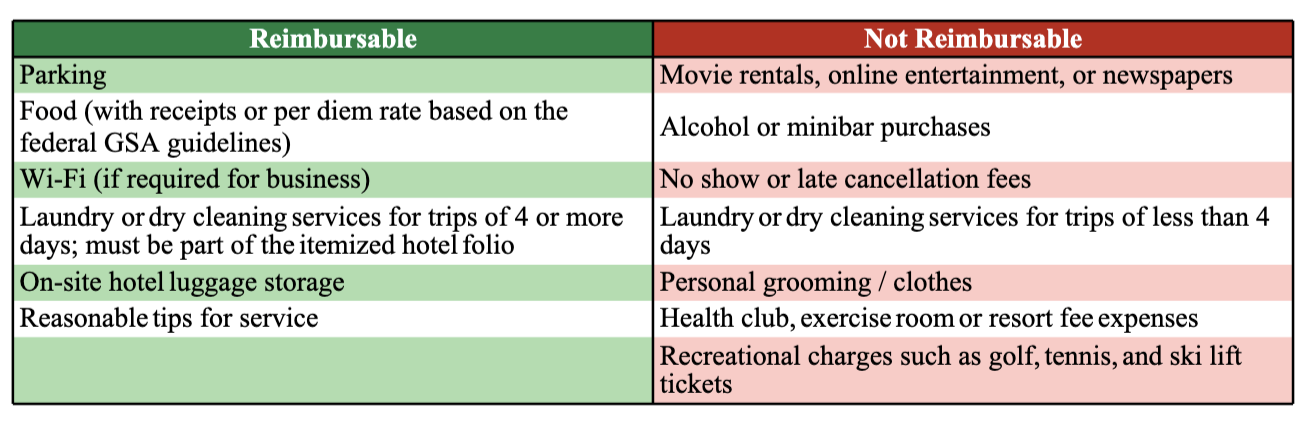
- Incidental Expenses Related to Business Travel (Below list is for illustration and not meant to be all-inclusive. See Appendix for additional details)
|
Reimbursable |
Not Reimbursable |
|
Parking |
Movie rentals, online entertainment, or newspapers |
|
Food (with receipts or per diem rate based on the federal GSA guidelines) |
Alcohol or minibar purchases |
|
Wi-Fi (if required for business) |
No show or late cancellation fees |
|
Laundry or dry cleaning services for trips of 4 or more days; must be part of the itemized hotel folio |
Laundry or dry cleaning services for trips of less than 4 days |
|
On-site hotel luggage storage |
Personal grooming / clothes |
|
Reasonable tips for service |
Health club, exercise room or resort fee expenses |
|
|
Recreational charges such as golf, tennis, and ski lift tickets |
- Meals
- General
Travelers have two options when submitting for reimbursement of meals:
- Per Diem meal rates following the current GSA Per Diem Rate guidelines, which do not require receipts; or
- Direct meal expense code with the corresponding receipts (not to exceed GSA rates). Total value of meal receipts submitted per day for reimbursement should not be in excess of the aggregate GSA daily rate.
Utilization of the per diem meal rates requires an overnight stay and should not be used for local daily travel.
Gratuities: when using the GSA per diem rates, additional reimbursement for gratuities will not be provided. Gratuities on direct meal expense submissions are limited to a reasonable amount for services and are not to exceed 20% of the food and nonalcoholic beverages expensed.
- Personal Meals (Individual)
Actual meal costs are reimbursable, up to the GSA rates. Meal rates for travel beyond the continental United States will conform, as nearly as possible, to the standards established by the federal government.
No meal allowance will be granted in instances when meals are covered by conference or registration fees, or any other situation in which the Traveler is provided a meal option and does not pay for the meal.
One-Day Travel Status: Reimbursement for meal expenses, where one employee is present and when no overnight travel is involved requires that the meal reimbursement be reported to the IRS as taxable income to the employee (see “Business Meals” below for guidance on meals with more than one employee present).
https://www.gsa.gov/travel/plan-book/per-diem-rates
- Business Meals
Business meals are allowable if the meal is directly related to the active conduct of University business, such as a substantial and bona fide business discussion. Two or more individuals are required for a business meal. In accordance with IRS regulations, the University will allow business meal expenditures for meetings with University employees; however, the IRS and the University will look to the frequency and business substantiation in reviewing the appropriateness of these business expenditures.
When two or more employees are dining together on University business, the senior ranking employee must pay for the meal and submit the expense report or, in the event of a multi-department event, the hosting department will be responsible for expensing the cost incurred. The business purpose and list of attendees, business titles, and company name, if applicable, must be provided. The University will reimburse for business related meals only where the individual allocation amount does not exceed $100.00 per person (unless separately approved by cognizant dean or vice president and above, including officers of the University).
- Meal Receipts
For non-per diem meal reimbursement request, Travelers are required to provide itemized meal receipts for all meal and entertainment categories.
- Conferences
When using a per diem meal rate, Travelers must provide a copy of the conference agenda and indicate which meals were and were not provided by the conference. Only meals not provided by the conference are reimbursable.
- Alcohol
- Entertainment
Entertainment expenses are expenses that are: (i) incurred during a meal or an event that is business related and also social or celebratory in nature, and (ii) attended by at least one non-Temple attendee (i.e., not a University employee or student). Entertainment expenses include food and beverages (including alcohol), catering services, banquet facilities, decorations, and musical groups. Payments to a non-University caterer, facility, or transportation provider must be processed against a purchase order issued by the Purchasing Department. See Catering below.
- Special Occasions
The cost of holiday, retirement, and office gatherings, when determined to have a business purpose and be in the best interest of the University, may be reimbursed when approved (prior to the expense being incurred) by the cognizant dean or vice president and above (including officers of the University).
- Catering
Aramark Catering Services, doing business as Cherry & White Catering Company, must be used for all catering activities on the University’s main campus and its Health Sciences Campus located in North Philadelphia. If Aramark is unable to provide services for any reason, you must complete the Catering Exception Form (which can be found by entering “catering” in the search box under “University Forms” on TUPortal) and obtain approval from Business Services in advance of the catering activity. Exceptions are also required for all off-site catered events. When appropriate, payments to a non-University caterer, facility, or transportation provider should be processed against a purchase order issued by the Purchasing Department. Whenever possible, catering should be invoiced to the University (rather than being submitted for reimbursement).
https://tuportal5.temple.edu/web/home-community/staff-tools
- Donations, Contributions, and Sponsorships
Donations, contributions, and sponsorships must be approved in advance by the Vice President for Finance and Treasurer and paid directly by the University to the receiving organization.
The use of University resources (including University funds) for political campaign activities is strictly prohibited under Temple’s Political Campaign Activities Policy. This includes political donations, contributions, and sponsorships.
- Gifts and Flowers
Gifts to employees are subject to review for taxability and payroll reporting. They also require approval by the cognizant dean or vice president and above (including officers of the University).
- Professional Organization Dues/Fees
Professional organization dues/fees in the name of Temple University are reimbursable. Professional fees in the name of the individual may be reimbursable if corporate membership is unavailable or if there is a direct business relationship that is in the best interest of the University and is approved by the cognizant dean or vice president and above (including officers of the University).
- Moving Expenses
Moving expenses are reimbursable in accordance with the terms of specific employment agreements with the University. Such items are generally treated as taxable income to the recipient.
- International Travel
All international Travelers must have a working mobile phone. When traveling internationally Travelers are expected to have international coverage turned on with their service provider during the period of travel. When practical, Travelers should use Wi-Fi (instead of cellular service) to communicate. Appropriate related charges will be reimbursable as set forth herein.
All faculty, staff, and students engaging in University affiliated international travel are provided with international medical and security emergency travel services. Membership is provided by the University and is administered by a third-party provider that specializes in these services. This medical and security assistance program provides 24-hour emergency response, as well as online services and travel information. Prior to the commencement of travel, all international Travelers are required to register their itinerary with the University’s international medical and security travel provider. Travel arrangements booked through Concur and World Travel are registered automatically. International travel booked outside of Concur or World Travel requires separate registration.
Travelers undertaking international travel must review and consult Temple’s International Travel Policy for additional requirements, international insurance coverage and benefits, resources, and guidance.
- Payment Applications
Except where alternative payment methods are not practicable and pre-approval from a dean or vice president and above (including officers of the University) is received, reimbursement of peer-to-peer (“P2P”) or person-to-business (“P2B”) payments using cash or peer-to-peer payment applications, such as Venmo, PayPal, Apple Cash, Google Pay, Zelle, Cash App, etc., are not allowable and will not be reimbursed.
- Receipts
Excluding per-diem meals and mileage, itemized receipts are required for all expense reimbursements in excess of $25. In the event a receipt is lost, the Traveler should attempt to contact the vendor for a copy of the itemized receipt. Absent an itemized receipt, the Traveler should attempt to obtain an itemized credit card transaction report. If an itemized invoice or transaction report is not available, the Traveler should submit a lost receipt affidavit form, which can be obtained within Concur.
Whenever two or more University Travelers incur a travel expense together, the senior (based on hierarchy) of the Travelers is responsible for settlement of the expense.
- Submission Due Dates
Travel advance request and expenses must be appropriately accounted for and requested and/or submitted for reimbursement within a reasonable period of time.
- Travel advances are provided within 30 days of the disbursement.
- Excluding extended travel arrangements (in excess of 30 days) and sabbaticals, expenses are required to be submitted for reimbursement within 60 days of the expense being incurred. For extended trips and sabbaticals, expenses must be submitted within 60 days of the conclusion of the travel arrangements. Untimely expense submissions may result in reimbursement requests being denied or reimbursements being considered taxable income.
- Any excess reimbursement must be returned to the University within 60 days of the expense being incurred.
Failure to comply with the requirements may result in disciplinary action.
- Exceptions
In instances where these procedures do not provide specific guidance for situations encountered by a Traveler, the Traveler's cognizant dean or vice president and above (including officers of the University) may provide guidance, as long as such guidance is consistent with the prevailing principles that such expenses are both reasonable and appropriate and exclude personal costs.
The Controller’s Office has the authority to grant exceptions to the University’s travel and expense procedures after such a need has been reviewed and approved by the Traveler’s cognizant dean or vice president and above (including officers of the University). Travelers may request an exception using the “Request for Travel Exception” form, which must be approved by the Traveler’s cognizant dean or vice president and above (including officers of the University) and the Controller’s Office BEFORE submitting for reimbursement.
The exception request form can be obtained by searching for “travel exception” in the “University Forms” section, which is located in the “Staff Tools” section of the “TUportal”. Catering exceptions, require approval of business services as noted in the “Catering” section above.
https://tuportal5.temple.edu/web/home-community/staff-tools
*****
Additional Information:
For questions, additional detail, or to request changes to this policy, please contact the Controller’s Office.
Revision History (and effective dates):
July 18, 2022 - Editorial change: the word “scholarship” was changed to “sponsorship” in section titled “Donations, Contributions, and Sponsorships”
July 1, 2022 - Procedures issued and effective.
Appendix
A1. Sample Car Rental Invoice is provided below
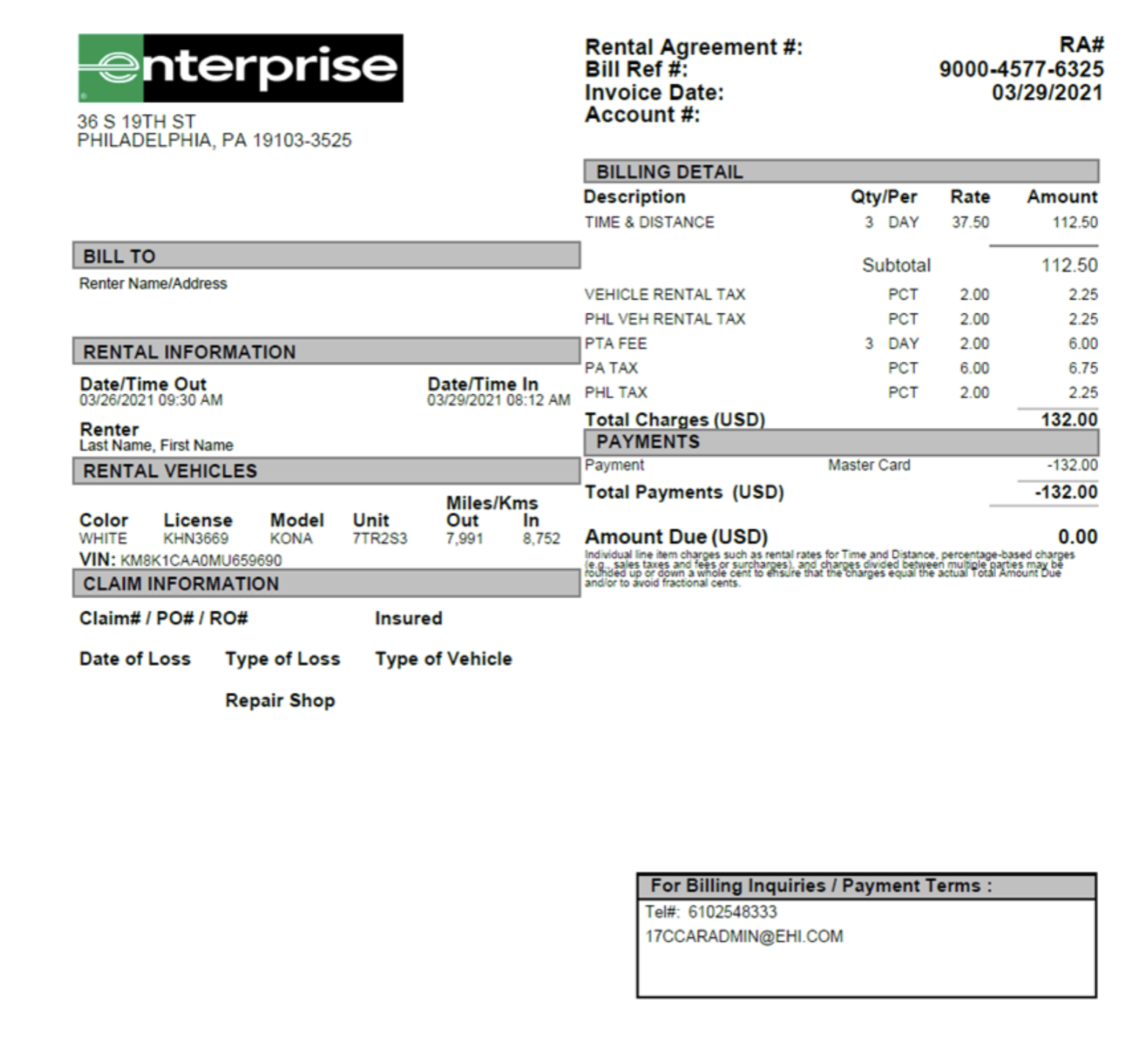
A2. Sample Transportation Calculation: Limousine, Shuttle Service, Uber or Lyft- Sample calculation to determine most affordable mode of transportation.
To evaluate the cost effectiveness of a Shuttle Service vs. Parking a personal vehicle, a user should consider the daily rate and the number of travel days. For example, short-term parking rates are significantly higher than economy or long-term parking rates.
Illustration: If you have a 3-day trip and park for $44/day = $132.00. however, a shuttle or car service is available for $50.00 each way or $100.00. In this case, a car service is more appropriate.
Conversely, if you go on a 3-day business trip and park in economy or long term for $24.00/day =
$72.00. If the car service is $50.00 each way, then parking is the more appropriate and economical choice.
A3. Expense Type Exclusion List
Temple University will not reimburse or pay for expenses that are personal in nature or deemed unreasonable under the circumstances. The following are some examples of expenses that will not be reimbursed. Please note that this list is not exhaustive. Questions about specific expenses that are not listed below should be directed to travel@temple.edu.
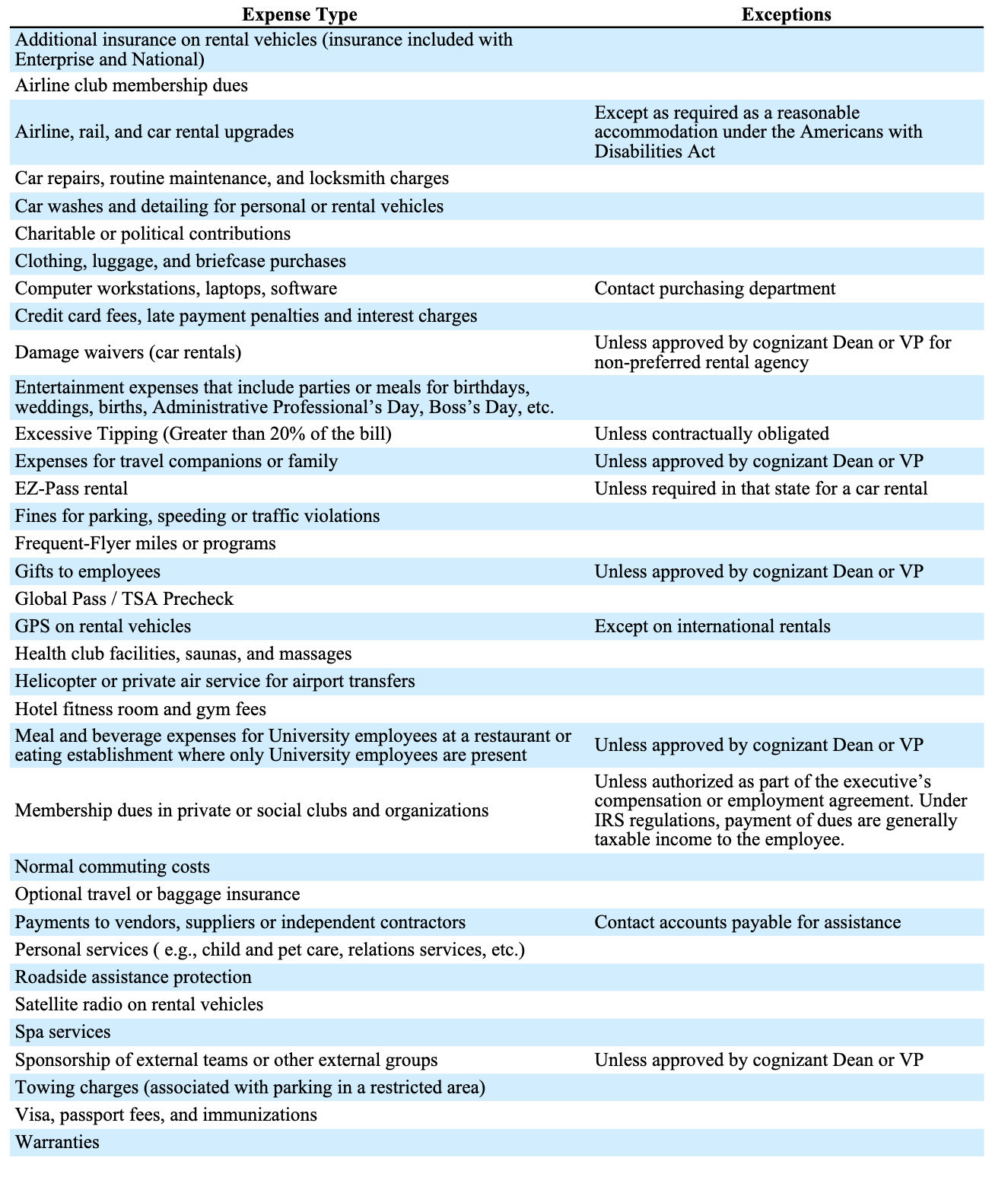
Expense Type Exceptions
Meal and beverage expenses for University employees at a restaurant or eating establishment where only University employees are present
Unless approved by cognizant Dean or VP
Airline club membership dues
Airline, rail, and car rental upgrades
Except as required as a reasonable accommodation under the Americans with Disabilities Act
Car repairs, routine maintenance, and locksmith charges Charitable or political contributions
Computer workstations, laptops, software Contact purchasing department
Damage waivers (car rentals)
Unless approved by cognizant Dean or VP for non-preferred rental agency
Excessive Tipping (Greater than 20% of the bill)
Unless contractually obligated
EZ-Pass rental
Unless required in that state for a car rental
Frequent-Flyer miles or programs Global Pass / TSA Precheck
Health club facilities, saunas, and massages
Hotel fitness room and gym fees
Helicopter or private air service for airport transfers
GPS on rental vehicles Except on international rentals
Gifts to employees Unless approved by cognizant Dean or VP
Fines for parking, speeding or traffic violations
Expenses for travel companions or family Unless approved by cognizant Dean or VP
Entertainment expenses that include parties or meals for birthdays, weddings, births, Administrative Professional’s Day, Boss’s Day, etc.
Credit card fees, late payment penalties and interest charges
Clothing, luggage, and briefcase purchases
Car washes and detailing for personal or rental vehicles
Additional insurance on rental vehicles (insurance included with Enterprise and National)
Membership dues in private or social clubs and organizations
Unless authorized as part of the executive’s compensation or employment agreement. Under IRS regulations, payment of dues are generally taxable income to the employee.
Normal commuting costs
Normal commuting costs
Payments to vendors, suppliers or independent contractors Contact accounts payable for assistance
Payments to vendors, suppliers or independent contractors Contact accounts payable for assistance
Personal services ( e.g., child and pet care, relations services, etc.)
Roadside assistance protection
Roadside assistance protection
Spa services
Spa services
Sponsorship of external teams or other external groups Unless approved by cognizant Dean or VP
Towing charges (associated with parking in a restricted area)
Towing charges (associated with parking in a restricted area)
Warranties
Warranties