
Preparation of Proposals
In this section you will find explanations on how to work with the ORA to prepare a grant application or other request for external funding. The chart below outlines the primary administrative milestones involved in submitting a request for external funding.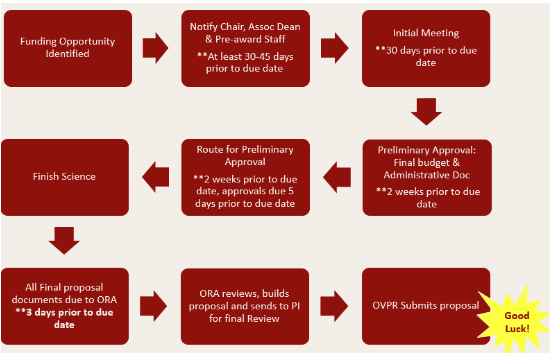
Who Can Submit a Proposal for External Support?
Project Directors and/or Principal Investigators (PD/PI) on sponsored programs (grants or contracts) have important financial, administrative, and supervisory responsibilities to the university. It is necessary that those who fill these roles have appropriate training, support, and oversight.
The policy of Temple University is that only full-time faculty members and designated administrative research positions may routinely serve as Principal Investigators on sponsored programs.
Other individuals may be able to serve as PI. For example, a doctoral student may serve as PI on an NIH F31 application. That determination is made for each application and the role is requested through OVPR. ORA staff will assist in this process.
OVPR Request for Principal Investigator Status - The privilege to serve as a PI or Co-PI on internally and/or externally sponsored projects is conferred to Temple University research faculty members and other staff as specified by schools and colleges in alignment with OVPR guidelines. Typically, tenure and research track faculty are eligible to serve. Faculty instructors, non- faculty research personnel, adjunct faculty, visiting faculty, students and post-docs are not eligible to serve as PIs but may serve as Co-PIs (alongside their supervising faculty member) with approval from OVPR and when the funder permits such an arrangement. These approvals are considered on a case-by-case basis. To be considered for Principal Investigator status for a specific proposal, the “Request for Principal Investigator Status” form must be completed with candidate signature, dept. chair signature, assoc. dean for research signature and VP for research signature. The pre-award team will facilitate gathering all signatures and is responsible for implementing this form when necessary.
What Requires Internal Review?
Internal reviews are required for all the following types of requests to external funders, regardless of the submission mechanism, sponsor type, or amount of funding:
- New proposals and resubmissions
- Letters of Intent (LOI) if sponsor requires an amount requested or budget, please check with ORA
- Continuations, progress reports, and renewals
- Supplements and amendments to current grants
- Contracts
- Subawards
Limited Submissions
Notify the ORA immediately if you are interested in an opportunity that limits the number of applications submitted by an institution. Our office must coordinate through OVPR. OVPR may open an internal competition, which can take several weeks.
Partnerships with Industry
If you are interested in pursuing a partnership with industry, please contact the Associate Dean for Research before proceeding. Contractual relationships like these can intersect with the policies and procedures of the Office of the Vice President of Research. They can also intersect with university policies regarding external employment, extramural compensation, and conflict of interest. This potential overlap would result in the discussions needing to be reviewed by OVPR and processed as a sponsored project, prior to a final budget and scope of work being presented to the sponsor. These policies apply to contracts as well as grants and are not limited to research-related endeavors. The Associate Dean for Research will assist you in determining relevant policies and resources available to proceed in a positive direction.
General Breakdown of Responsibilities
The following table summarizes the areas of responsibility for the PI versus ORA staff during the application process. Additional details will be provided after the initial meeting, customized to each proposal.
| Item |
Pre-Award Administrator |
Principal Investigator |
| Funding announcement | Know the guidelines and answer any questions the PI may have | Review guidelines and ask for any clarification |
| eRA Record | Create application in eRA, fill forms, and upload documents, route for approvals, and final reviews | Review documents to ensure final versions are uploaded |
| Personnel | Contact key consultants and subawards for COIs, subcontract materials, etc. |
Provide contact information for consultants and subawards
Contact key personnel for biosketches and facilities/resources |
| Budget | Draft budget and work with PI to develop | Provide budget items and approval final budget |
| Budget justification | Prepare and provide budget justification template | Complete and provide details on final budget justification |
| Non-Science documents |
Prepare and provide draft documents, as appropriate, ensuring font, margins, and page length are compliant Provide policy guidance |
Review and finalize documents |
| Science Documents | Provide policy guidance and review final documents for font, martin, page length, and other compliance factors per sponsors requirements | Draft and finalize documents |
Initial Meeting
Please reach out to your pre-award contact as soon as you begin to consider developing a grant application. We will review the funding announcement and set up a meeting to discuss the administrative portions of the application. Below are typical topics and questions that we will discuss during the meeting.
- Send funding announcement in advance
- Describe the project in basic terms
- Be ready to discuss the resources you need including space and personnel
- Who will be key personnel?
- Will this be an MPI?
- Subawards, consultants, volunteers
- We will need contact information for all external personnel (including research offices at subaward institutions)
- Non-personnel costs (participant costs, outside vendors, travel, equipment, etc)
- Free resources such as in-kind donations
- Requests for college support (release time, tuition)
- Bring other information needed for set-up
- IRB or IACUC (pending or approved)
Budget
The information established in our discussion will be used to create a draft budget on the CPH template, this ensures that the correct rates and calculations are reflected in the budget. We will send you the budget for your review, pointing out where expenses may need to be reduced or increased, and we will work together to finalize the numbers. These are some of the questions we will ask during the meeting:
- How much time (effort) will you need to devote to this project during the academic year? Summer?
- Have you discussed this project with your chair (i.e., course release)?
- What other Temple faculty and staff will be on the project?
- Will you need graduate research assistants (RAs) on the project?
- Will there be subawards/subcontracts?
- Will there be consultants?
- What participant-related expenses will you have?
- What supplies and equipment will you need?
- Will there be clinical procedures from TUHS (such as blood draws or MRIs)?
- Will the project involve cost share or match?
- What F&A rate will the project use? Is it on- or off-campus?
Other Questions
- Will you need additional space if the project is funded?
- Is this a submission to a foundation? If so, we will confirm the submission with Institutional Advancement.
- Do you need to submit an IRB application?
- Are there any conflicts of interest (real or apparent)?
Follow-Up
After the meeting, we will send you:
- Timeline for internal deadlines
- Draft budget
- Detailed checklist for each piece of the application
Effort Guidelines
Grant applications are routed through the Office of Research Administration for review prior to submission. This review is conducted for several reasons. The review is to ensure that investigators are making appropriate effort requests that accurately account for the time dedicated to a project and are consistent with the spirit of the Work Effort Policy of the college. Applications are also reviewed in the context of an individual investigator’s rank and with emphasis on supporting the successful development of our faculty. Financial issues at the department and college level also are considered in the evaluation of the budget for a grant application Please use the following guidelines in the creation of your budgets for Key Personnel:
| Project Role |
Recommended Effort |
| Principal Investigator | 25-40% |
| Co-Investigator (collecting data locally as sub-award PI) | 10-20% |
| Co-Investigator (contributing expertise with Temple or as sub-award | 10% |
| Biostatistician (sample minimum effort for 5-year project) | 10-15% |
| Data manager | 20-50% |
| Research analyst | 100% |
| External consultant | $200/hour |
Below are additional guidelines:
- If you wish to have lower effort for any faculty within the college, please reach out to the Associate Dean of Research with an explanation for the request.
- Make effort requests in increments of 5% (i.e., 5%, 10%, 15%, etc.). Atypical requests, such as 9%, invite a reviewer to drill down and review a budget in detail, which opens the door to unnecessary criticisms. The 5% increments have intuitive appeal and raise fewer questions, leading the reviewer to focus on the science.
- Provide an appropriate written justification for effort requests. For a Co-Investigator contributing expertise to a project and requesting 10% effort throughout the project, an appropriate justification would be: “Dr. X has made substantial contributions to the preparation of the application. She will actively participate in regularly scheduled meetings of the research team that focus on participant recruitment and data collection. She will remain available for additional communication via email or telephone as needed. In later years, she will contribute to data interpretation and manuscript presentation.” Such a narrative makes it easy for a reviewer to see how Co-Investigator X will spend approximately 4 hours a week on the project.
- Ensure that the budget will allow for a robust investigation of the research question in the face of anticipated budget cuts. If, as the Principal Investigator, you only “need” 25% support for your effort, request 30%. When your budget is cut at the time of award, it can be one of the first cuts you make. As faculty salaries frequently are some of the largest expenses, a cut like this can provide additional flexibility to support other research personnel and equipment purchases.
- If a project will have multiple PIs, the contact PI is expected to have a slightly higher level of effort. An additional 5% effort for the contact (primary) PI would be appropriate to cover the additional administrative burden.
- Finally, when you are working as a subcontract to a study being led at another institution, you are encouraged to share these guidelines with your collaborators at the start of your planning of the application. Some institutions try to minimize funding passed through to sub-awards. Stating your expectations upfront will ensure that the overall project budget is developed with appropriate effort for your role.
Budget Development Guidelines
Most importantly, your pre-award contact will talk with you about the budget and work closely with you to develop a budget that will provide the resources you would need to successfully complete your aims.
The following guidelines address direct costs to the sponsor.
General Principle
Researchers should not be afraid to submit large budgets to a sponsor. Ensure that the budget will allow for a robust investigation of the research question in the face of possible budget cuts.
It can be tempting to submit lean budgets, assuming that the reviewers will see this as efficiency. However, lean budgets might indicate that you have not thought through all the resources needed to successfully complete your project. They also make you vulnerable to budget cuts and require you to use PI funds to supplement a project that is underfunded.
Personnel
Faculty Effort
Refer to the previous section for effort guidelines per role. Below are additional guidelines.
Collaborators outside CPH. Schools and colleges within Temple, as well as other universities, may have different guidelines. Your collaborators should follow the guidelines applicable to them and that are in the best interest of your project.
Biostatistician Support
Adequate biostatistical support is essential to the success of every research project. For this reason, it is essential to ensure that you work with a biostatistician as you develop your grant proposal and that your budget includes adequate support for the actual effort devoted to the project. In rare instances, such as where data are already entered and cleaned and the study protocol is very
simple, 5% effort (corresponding with 2 hours per week) may suffice. Realistically, however, most projects require considerably greater effort, typically at least 10% effort with higher effort (at least 15-25%) in data analysis years. Biostatisticians contribute to your project in every phase, not just once it is time to write up the first key paper. They can provide advice around issues of sampling, design, measurement, and help you to avoid common mistakes. Biostatisticians will also participate in terms of providing allocations to study treatment arms and working with Data Safety and Monitoring Boards. Since biostatisticians are typically spread across numerous different projects, it is essential to ensure that you have budgeted sufficient protected time for these key personnel for the level of access to their time that your project requires.
Key Personnel
As you consider who to list as key personnel, think about those individuals who are uniquely contributing to the success of your project and who cannot be replaced. Limit the number of key personnel.
Staff
Large projects might require a full-time project coordinator to assist the PI in managing a project. This is especially true if your project will include significant scheduling with participants, coordination with subawardees, or other items that require someone to be available during normal business hours. Remember that a full-time staff member can take advantage of tuition remission at
Temple University to pursue a degree.
Data management needs are also becoming more sophisticated; consider your needs for this. Personnel can be shared across projects or even between investigators. Consider how you can fund a data manager, for example, by paying for one across projects.
Part-time staff also can be utilized. These positions can be especially useful if your staffing needs will vary over the course of life of the project, as they provide flexibility concerning hours worked and end dates.
Graduate Students
Graduate students at the master’s and doctoral level are in the Temple University Graduate Student Union (TUGSA) union. There are designated appointment types, hours, and lengths of contracts available. The research administration staff can walk you through the options and costs. Graduate students must have their tuition paid. It is advised that tuition be included, if allowed by
the sponsor. Refer to Section 12 for more details.
Non-Personnel
The PI has a responsibility to maximize the use of grant funds to support grant activities. This will reduce the financial burden on departments and ensure that the proper funds are supporting the appropriate activities. Therefore, the research administration staff work closely with faculty to ensure that all appropriate expenses are included in budgets and charged to grants.
Below are some categories of expenses that PIs may forget to include but that can be charged to a grant in the right circumstances. These categories include, but are not limited to:
The PI will also want to properly account for research-related items such as participant incentives, consultant costs, local travel for data collection, small equipment, and its replacement over the life of the project, chemicals, and fees for blood draws.
F&A Costs and Policy for Reduced Rate
The Department of Health and Human Services establishes Temple University’s indirect costs percentage, also referred to as the F&A rate. Unfortunately, many of the agencies that support research in our college have their own established rate for indirect costs or do not provide indirect costs at all. While this is less –than ideal, the university honors these published rates.
The Office of Research Administration sometimes receives requests from faculty members to allow a project budget to use a lower indirect rate than a sponsor allows. These exceptions are considered on a case-by-case basis and should be relatively rare. Our established indirect rates are not negotiable, except under extenuating circumstances. If you anticipate a scenario where indirect
rates need to be negotiated, please contact the Associate Dean for Research early in the grant application process. Exceptions will be granted when appropriate for the project and in the spirit of supporting our research mission.
Subawards and Consultants
The difference between subawards and consultants can sometimes feel vague. Please see the below definitions as well as the chart to determine whether your proposed collaborator is a Consultant or a Subaward.
Consultants
Consultants provide advice and services for a fee that is clearly laid out in the letter of support. The letters should include rate/charge for consulting services and level of effort/number of hours per budget period anticipated. In addition, letters ensuring access to core facilities and resources should stipulate whether access will be provided as a fee-for-service. Consultants generally offer only advice or propose solutions to problems, but they do not direct, carry out, or implement solutions. Grantees should describe in the budget justification the services to be performed by the consultant(s) and include the number of days of anticipated consultation, the expected rate of compensation, travel, per diem, and other related costs for each.
Generally, a consultant is not considered senior/key personnel. However, if the consultant contributes to the scientific development or execution of a project substantively and measurably, he/she should be designated as senior/key personnel and would be included in the senior/key person profile component. When a consultant is designated as a “key consultant” they will need to provide a biosketch in addition to their letter of support and will need to come under Temple University’s FCOI policy. For this reason, it is imperative that any “key consultants” be identified early in the process and be put in contact with the FCOI office at Temple University. Your pre-award administrator will facilitate this.
Subrecipient
Subrecipients, on the other hand, are involved with the PD/PI in the scientific development or execution of a project–rather than providing advice, goods, and services for a fee. They can make independent decisions related to the design, conduct, or reporting of the funded research. They have responsibility for programmatic decision making and contribute to the scholarly/scientific
conduct of the project as described in the statement of work. The subaward investigator would be considered a co-author of publications resulting from the work performed under the prime award and performs work that involves human subjects or animal studies. They will perform the work as part of their institutional appointment as well as manage technical and administrative aspects of a portion of the overall project statement of work, often while using facilities and employees of the subcontracted organization.
| SUBRECIPIENT (AKA SUBAWARD/ SUBCONTRACT) |
VENDOR (AKA CONTRACTOR) |
EXTERNAL CONSULTANT |
| An entity that has agreed to work in collaboration with the CPH PI to perform a substantiative portion of the programmatic effort of an award. |
An individual, business, or other entity which supplies products or services to the University. |
An individual or business whose expertise is required to perform the project. Services are temporary and special or highly technical. |
|
|
|
Cost Share Requests
In general, the Associate Dean for Research will consider cost sharing requests under the following circumstances:
- Cost sharing or matching funds is required by the funding agency;
- Principal Investigator start-up funds, Principal Investigator 16-account funds, and/or Departmental 16-account funds are not available; and
- The investigator can make the case that the project is a platform to larger grants to support
the work in the area.
If you are considering an application that will require a cost share, please inform the Associate Dean for Research 30 days in advance of the submission deadline. This will allow for an evaluation of the project and the request for supplemental funds.
eRA Records
eRA@TU is the University’s system for internal approvals and submitting grants.gov applications. It uses your TU accessnet login and provides security for the sensitive information in your proposals. The system also automates the internal approval process, by identifying the correct approval chain for all faculty and other key personnel.
Timeline for Sponsored Project Review/Approvals
Temple University employs a two stage approval process for all applications and continuations.
PRELIMINARY REVIEW: Starts 14 days before the sponsor deadline
Documents needed for review:
- Final budget
- Final budget justification
- Final subaward budgets, justification and all signed documents (if applicable)
- Biosketch (if needed by sponsor)
- Facilities
- Project summary/Abstract (can be draft)
- CPH cover memo (created by your pre-award specialist, uploaded in Temple Docs)
- Request & justification for cost share, space, and other resources not requested from sponsor
Who Reviews
- All key personnel
- Laura Vassallo; Director of Research Administration
- All chairs of key personnel (including those internal to Temple but outside of CPH)
- Associate Deans of Research (CPH: David Sarwer)
FINAL REVIEW (3- days before grant is due to sponsor)
All application documents must be complete and Final and forwarded to your pre-award specialist (or available in shared drive).Pre-award specialist will review all documents prior to finalization, and will provide PI with full application for approval. After PI approval, the pre-award specialist will submit the eRA record to Central Grants Office (OVPR) for final review:
- Only the central Grants Management office can submit an application and sign application documents.
- OVPR will reach out to the PI and your pre-award specialist if any adjustments need to be made.
- OVPR will submit to sponsor once review is complete and all questions (if any) have been addressed.
Waivers
A waiver request for emergency processing may only be requested by the Associate Dean for Research to the Vice President for Research. The decision to request a waiver will reside with the Associate Dean. Your CPH research administration contact will work with you to prepare the waiver and will submit it to the Associate Dean. The decision to grant or deny a waiver will be determined by the Vice President for Research.
Special Circumstances
Office of Research Administration staff may require earlier deadlines under special circumstances. If this is necessary, deadlines will be discussed and set during the initial budget development meeting and put in writing. Examples include proposals due on the NIH standard deadlines when multiple applications are being prepared; projects that require approvals from multiple departments or schools/colleges; and accommodating dates when approvers will be unavailable.
Late Submissions
Please note that grant application materials received by the Office of Research Administration and Temple Grants Management after the internal deadlines noted above will be processed on a first-come, first-served basis. While every effort will be made to accommodate late submissions, it cannot be guaranteed that a sponsor deadline will be met under these circumstances.
Approvals: Roles and Responsibilities
This section outlines the roles and responsibilities for each party involved in reviewing and approving sponsored project applications and eRA records.
Principal Investigators (PI)
The PI, in signing the eRA record, agrees to:
- Accept responsibility for the intellectual content of the research or scholarly activity that is proposed;
- Accept responsibility to discuss quality and completeness of both the fiscal and technical portions of the proposal;
- Ensure that all necessary approvals are received prior to submission of the proposal to an outside funding source;
- Consult, early in the development process, with the department chair and associate dean to inform them of plans for preparing a proposal, and to discuss any special requirements that may be necessary, such as additional space, renovation of space, graduate student tuition support, or cost sharing/matching funds;
- A Cost Share Documentation Form is required if cost sharing will be included in the proposal.
- Any requirements for additional space or renovations must be made known to the department chair and associate dean and must be indicated in the eRA record prior to proposal submission.
- Avoid conflict of interest;
- Adhere to the principles of responsible conduct in research or other creative work;
- Assure that the sponsored project is conducted safely and in accordance with university, federal, state, and local regulations;
- Meet deadlines for the submission of the proposal and for the completion of reports to the
sponsoring agency; - Accept primary responsibility for administration of the awarded activity;
- Use funds for the awarded project appropriately, and to ensure that all expenditures are consistent with the terms and conditions of the award;
- Report potentially patentable or other commercial results in accordance with the university Invention and Patent Policy;
- Complete the work on schedule and within the project's agreed upon budget; and
- Assure compatibility with the total academic assignment.
Other Faculty
All faculty on a project – regardless of their project role – must approve the eRA record to verify their role, effort, and salary calculations, as well as facilities and other resources available to support their role in the project.
In certain cases, approvals may be needed unrelated to faculty effort. For example:
- Director of the Institute for Survey Research
- Radiology Department Chair and Business Administrator if a project includes MRI or other radiology services
Department Chair/Center Director
Department chairs and center directors are responsible for knowing about all research or sponsored activities that are being conducted in their units.
The approval of the department chair or center director indicates acknowledgement of the:
- Research or creative activities that are being conducted in the department;
- Research or creative activity conforming to the short or long-range objectives of the department;
- Needs of the proposal in terms of space requirements, materials, staffing, or health and safety hazards associated with the conduct of the activities (the Department Chair may need to discuss the special requirements with the Associate Dean before signing the eRA record form);
- Commitment to provide any necessary requirements, such as space or renovations, if the proposal is funded;
- Spproval of release time for designated faculty;
- Coverage of any cost share, over expenditure, or disallowed expenditures from departmental funds;
- Adherence to all applicable college/school and university procedures; and
- Competency of the PI to conduct and manage the proposed project.
Office of Research Administration
The associate dean for research is responsible for the research and other sponsored activities that are conducted in his or her specific school or college.
The Associate Dean, in approving the eRA record, assures that he or she:
- Acknowledges the proposed project;
- Recognizes the project as compatible with the institutional goals and objectives of the college or school;
- Makes available staff and space necessary for conducting the project;
- Recognizes personnel descriptions as appropriate and consistent in the college/school;
- Notes all aspects of the proposal which may influence budgets, such as matching funds, as well as procedures specified to meet these obligations;
- Attests that the Associate Dean is committed to providing specific requirements, including space, if the proposal is funded, or is assured that funds are available from other sources;
- Identifies post-doctoral appointments which satisfy college/school requirements; and
- Identifies any over expenditure or disallowed expenditures that may require coverage from college/school funds.
Grants Management (OVPR)
Grants Management is responsible for approving proposals and administering sponsored projects, protecting, and commercializing intellectual property, and insuring compliance with awarding agencies requirements. In particular, the Vice President for Research or designee is responsible for signing proposals on behalf of the university after all other necessary approvals have been obtained by the principal investigator and before proposals are submitted to the funding agency. In signing on behalf of the university, Grants Management assures that the proceeding entities:
- Execute their responsibilities;
- Meet the special requirements of sponsoring agencies;
- Complete the proper internal clearances;
- Advise the appropriate officials of regular policy or any parts of the proposal that call for major fiscal or academic arrangements; and
- Accept the projects terms as outlined in the proposal.
Submission
You will work with ORA to complete your application in eRA, and any other system required by the sponsor. Grants Management submits grants.gov applications (that is, applications being submitted directly to a federal sponsor). ORA will work with you to submit applications to other sponsors, after Grants Management has approved it for submission.